
Difference Between RD and FD: Which Is Better and When?
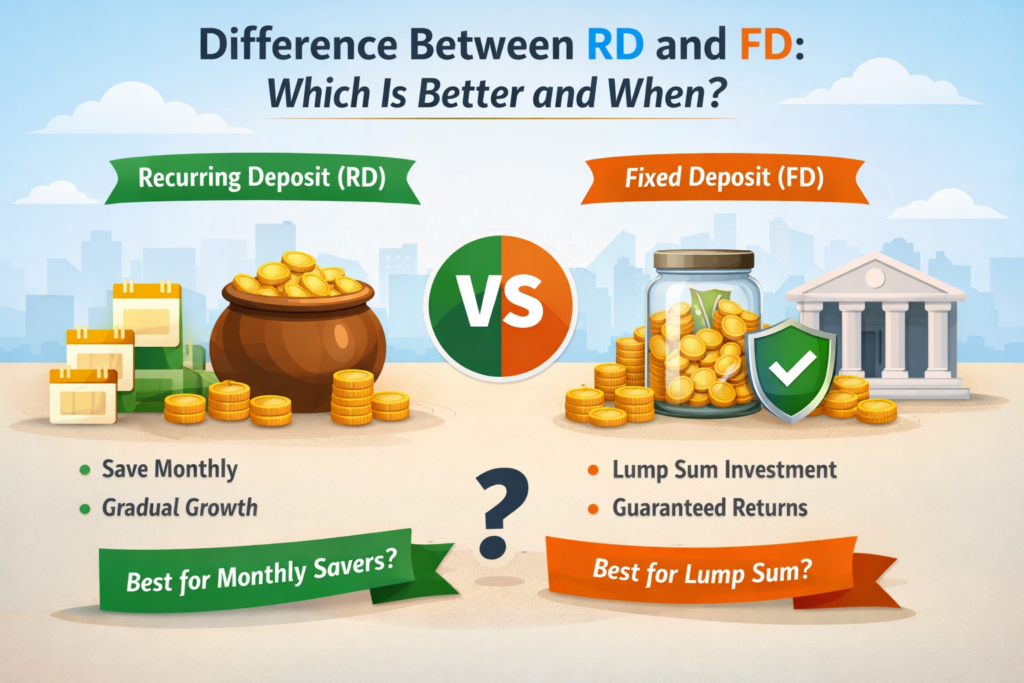
Difference Between RD and FD: Which Is Better and When?
Recurring Deposit (RD) and Fixed Deposit (FD) are two of the most popular and trusted savings options in India. While both offer stable and predictable returns, they are designed for different financial habits and goals. Understanding how RD and FD work, how time affects returns, and which option suits you better can help you make smarter saving decisions.
What Is a Recurring Deposit (RD)?
A Recurring Deposit allows you to invest a fixed amount every month for a chosen period. It is best suited for people who earn regularly and want to build savings gradually without investing a large lump sum.
Each monthly contribution earns interest for the remaining tenure. Over time, this disciplined approach helps create a sizeable corpus, especially for short- to medium-term goals.
To estimate how your monthly savings can grow, you can use an RD Calculator and plan your deposits accurately.
What Is a Fixed Deposit (FD)?
A Fixed Deposit involves investing a lump sum amount for a fixed tenure at a pre-decided interest rate. It is suitable for individuals who already have surplus funds and want guaranteed returns without market risk.
Interest in FDs is usually compounded quarterly or annually, depending on the bank. At maturity, you receive the principal along with the interest earned.
If you want to calculate the maturity amount of a lump sum investment, you can use a FD Calculator to get instant results.
How Time Impacts RD and FD Returns
Time plays a crucial role in both RD and FD investments, but in different ways. In an RD, earlier monthly deposits earn interest for a longer duration, while later deposits earn for a shorter period. This means discipline and consistency matter more than the amount.
In an FD, the entire amount earns interest for the full tenure. Longer tenures generally lead to higher overall returns due to compounding, making FDs more effective for lump sum investments over time.
Annual RD vs Annual FD
An annual RD is suitable for individuals who want to save monthly over a year for short-term goals such as vacations or emergency funds. An annual FD works better when you already have money available and want to lock it safely for one year.
While FD returns may appear higher due to the lump sum nature, RDs offer the advantage of flexibility and ease of saving.
Which Is More Beneficial: RD or FD?
Neither RD nor FD is universally better — the right choice depends on your financial situation and habits.
RD is better when:
You want to save regularly, do not have a lump sum, and prefer disciplined monthly investments.
FD is better when:
You already have surplus money and want predictable returns with minimal effort.
What Suits You Best?
If you are a salaried individual starting your savings journey, an RD can help build consistency. If you have received a bonus, inheritance, or savings and want capital protection, an FD may be more suitable.
Many investors use both options together — RD for monthly savings and FD for parking lump sums — to create a balanced and low-risk savings strategy.
Final Thoughts
RD and FD are not competitors but complementary savings tools. Understanding their differences, the role of time, and your personal cash flow can help you use them effectively. Choosing the right option at the right time ensures better financial stability and smarter money management.